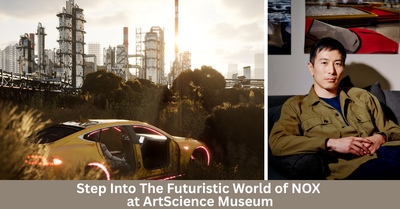

Another World Is Possible is an exhibition on the future, exploring the practice of world-building across cinema, architecture, design, and speculative fiction.

Venue: ArtScience Museum, Marina Bay Sands
Date: now - 22 Feb 2026
Opening Hours:
- Sun - Thu: 10am – 7pm (last entry at 6pm)
- Fri - Sat: 10am - 9pm (last entry at 8.15pm)
Fee:
- Singapore Residents: Adult: From S$18 | Concession: From S$15
- Tourists: Adult: From S$20 | Concession: From S$16
Another World Is Possible by ArtScience Museum
Another World Is Possible at ArtScience Museum reflects a distinctly Singaporean approach to imagining the future—one shaped by long-term thinking, environmental pragmatism, and a strong ethic of collective responsibility. In contrast to the dystopian narratives often found in Western popular culture, Singapore views the future as something to be designed, debated, and actively built. This ethos runs through the exhibition’s architecture, design, and art—from WOHA’s visions of biodiverse vertical cities to Pomeroy Studio’s concepts for floating farms.
Showcasing the visionary work of filmmaker and speculative architect Liam Young, alongside regional and international creatives such as Björk, Torlarp Larpjaroensook, Osborne Macharia, Ong Kian Peng, Jakob Kudsk Steensen, and Ming Wong, Another World Is Possible offers alternative ways of living, thinking, and being. It embraces a more hopeful vision of tomorrow, where resilience, creativity, and imagination guide the way forward.
Co-curated by ArtScience Museum and Liam Young, the exhibition is presented in partnership with ACMI, Melbourne, Australia, as a sequel to The Futures and Other Fictions, originally curated and developed by ACMI. It also stands as a key event of Singapore Design Week 2025, supported by the DesignSingapore Council.
The launch of Another World Is Possible marks not only the opening of a landmark exhibition but also the unveiling of the Museum’s new visual identity—inviting visitors to see new possibilities and envision bolder, brighter futures together.
Chapter 1 - We Are Authors of the End

For more than a century, cinema and television have shaped how we imagine the future. Long before today’s technologies - driverless cars, smart devices, virtual reality - became real, they were visualised on screen. These cinematic visions often presented the future as something to fear.
Many iconic films gave form to that anxiety, from Metropolis (1927) to Blade Runner (1982) to The Matrix (1999). The future on screen was dominated by the ominous rise of machine intelligence, the breakdown of societal order, and a planet scarred by ecological collapse. This imagery has proved enduring. For many of us, the future came to be defined by neon cities soaked in rain, synthetic bodies wired to data, and nature pushed to the edge. Dystopia became the default—a shared visual language that was dark, seductive, and hard to unlearn.
This chapter draws attention to the influence of those portrayals. With a widespread dominance in popular culture, these on-screen futures, have shaped how we build, plan, and imagine the future. In the gallery, a montage presents scenes of collapse, control, and catastrophe drawn from decades of cinema and television. Presented in sequence, they reveal a visual vocabulary that has been absorbed into public consciousness. The repetition of dystopian images has narrowed our capacity to see otherwise.
By beginning here, the exhibition invites a pause. Before looking ahead, we have to first revisit the futures we’ve inherited through popular culture - not to dismiss them, but to ask what might happen if we let them go.
Chapter 2 - Imagination Echoes Through Us All

Speculative fiction gives us another way to imagine the future. What began as a literary genre has evolved across mediums from design to comics to visual art. Unlike the dystopian visions that dominate cinema, speculative fiction invites us to consider what possible futures might emerge when shaped by diverse cultural values and ways of seeing.
This chapter begins with After the End by artist and exhibition co-curator Liam Young, in collaboration with Australian First Nations artist Natasha Wanganeen. Set in a post-fossil future where stolen land has been returned and new island communities rise from reclaimed oil rigs, the work presents a narrative shaped by Indigenous knowledge. This work is part of a broader practice in which Young uses cinematic world-building to reimagine the ecological, social, and spatial structures on which the future might rest.
When we encounter futures imagined by creatives across the Asia-Pacific, they often feel more generative than the dystopias we have come to expect. Throughout this gallery, designers and artists draw from cultural memory in an effort to prototype tomorrow. Osheen Siva reimagines traditional Tamil jewelry as futuristic armour, while Björk transforms love into a cosmic force, shaped by personal myth and elemental symbolism.
These works demonstrate how imagination can operate as a tool for redesigning the future. To create worlds grounded by inclusivity and hope, we must first be able to imagine them.
Chapter 3 - It Begins with Freedom

This chapter introduces Afrofuturism, a cultural movement that places the experiences, histories, and futures of the African diaspora at the centre of speculative thought. In contrast to Western popular culture, which has often overlooked the presence of Black voices in imagined futures, Afrofuturism reclaims the future as a space for Black freedom, creativity, and possibility.
Afrofuturism asks what the future might look like when shaped by the values of cultural memory, spiritual depth, and self-determination. It draws on music, mythology, and ancestral knowledge to create worlds that are technologically advanced yet grounded in memory and tradition.
The term Afrofuturism was coined in 1993 by cultural critic Mark Dery, but its origins stretch back further. One of the genre’s foundational figures is musician Sun Ra, who began developing his cosmic philosophy and interplanetary persona in the early 1950s. Fusing ancient myth, space travel, and avant-garde jazz, Sun Ra created a radical new aesthetic that imagined liberation through sound and stars.
That radical cosmology reverberates through the works in this gallery, from Osborne Macharia’s photographic portraits and Serwah Attafuah’s cybernetic warriors—who merge Ghanaian heritage with futuristic aesthetics—to Shiro Fujioka’s film of an interdimensional tribe that uses sound to move through time, space, and Black futures.
These works reject the myth of a universal future, asserting instead that all futurity is shaped by culture, history, and perspective.
Chapter 4 - Silk, Spice, a Punk Paradise

This chapter turns to Asia—particularly Southeast Asia—where the future feels alive with possibility.
It explores speculative genres such as Silkpunk, Spicepunk, and Islandpunk, which draw on regional mythologies, material cultures, and environmental contexts to imagine futures that are culturally specific to Asia. Where Afrofuturism engages with space, sound, and spiritual liberation, Silkpunk retools classical East Asian traditions through biomimetic technology and epic narrative. Spicepunk interrogates colonial trade legacies and maritime imaginaries in the archipelagic South, while Islandpunk reclaims Pacific and Southeast Asian island narratives through speculative design and environmental adaptation. Each of these genres rejects the notion of a singular, universal future, insisting instead that futures are plural, situated, and shaped by culture.
The contemporary artists and designers in this chapter give visual and material form to these genres. Leeroy New, Torlap Larpjaroensook, Ong Kian Peng, Youths in Balaclava, and others suggest a Southeast Asian futurity where tradition, technology, spirituality and innovation coexist. This vision is echoed in the 2023 film The Creator, which offers a cinematic portrayal of a future Southeast Asia shaped by harmony between humans, robots, and nature.
Together the exhibits articulate technologically advanced futures that remain grounded in culture, ecology, and place. In contrast to the dystopian tone of much Western science fiction, these Southeast Asian futures imagine a balance between technology, nature, history and community.
Chapter 5 - From Console to Cosmos

This chapter explores video games as powerful engines of world-building. These playable worlds allow futures to be imagined, tested, negotiated, and experienced firsthand. As laboratories of possibility, video games reveal the impact of individual decisions and foreground the agency involved in shaping alternative worlds.
Since entering mainstream culture in the 1970s and 1980s with role-playing epics like The Legend of Zelda (1986) and Final Fantasy (1987), games have continually expanded in scope and sensibility. Alongside action-based narratives, a gentler genre has emerged. Games such as Journey (2012) and Monument Valley (2014 – 2025) prioritise exploration and perception over conquest or competition, creating experiences shaped by care, wonder, and aesthetic attention.
The projects in this gallery carry that spirit into a Southeast Asian context. Debbie Ding’s New Village reconstructs a Malaysian town from her father’s memories, transforming personal and postcolonial history into an explorable virtual space. BARC, by the Interactive Materials Lab, reimagines the arcade shooter through barcode scanners and receipt printers, inviting collaboration and playful resistance to standard game mechanics.
Together, these games invite players to become co-creators of new worlds—exercising agency, shaping outcomes, and taking responsibility. Each player becomes both inhabitant and guardian of a possible future.
Chapter 6 - A World Becoming

For decades, popular culture has rehearsed the end of the world. Dystopian futures, marked by ecological ruin, have shaped how we imagine what lies ahead. The climate crisis gives these visions a terrible legitimacy. Yet dystopias carry a strange seduction. Once the world is seen as beyond repair, we believe we are absolved of the burden of fixing it. The story ends, and responsibility recedes. The projects in this chapter resist that impulse. Instead, a group of designers, architects, and artists offer radical propositions for how we might confront the climate crisis and conceive of futures still worth building.
Imagine a world where the entire human population lives in a single hyper-dense city powered by renewable energy, as envisioned in Liam Young’s Planet City. Farmers might adapt to rising seas by constructing buoyant farms, like those proposed by Jason Pomeroy. What if the colossal machinery of the fossil-fuel age were turned toward repair, as imagined in Young’s The Great Endeavor? Weather itself might become a medium of design, with cloud-seeding towers redirecting Asia's monsoon, as imagined by Ong Kian Peng.
These worlds may not be so distant. The projects in this chapter are grounded in real planetary challenges, drawing on emerging technologies and concrete sociological proposals. They are not only possible, but increasingly plausible. Together, they offer extraordinary and varied visions of tomorrow, inviting us to consider the futures we want, and the shared responsibility needed to bring them into being.
Chapter 7 - This Future Island City

Singapore is often described as a city of the future.
Its skyline has been featured in science fiction media, from Equals (2015) to Westworld (2016–2022), with the city's vertical gardens and living architecture now closely associated with visions of the future.
But what makes a place future-facing is not simply its cityscape or technologies. In Singapore, for 60 years, the future has been embedded in the infrastructure of governance, planning, and imagination. Through foresight institutions, such as the Centre for Strategic Futures and the Urban Redevelopment Authority, Singapore treats the future as a field of active design. What emerges is a different kind of futurism, less about acceleration and more about symbiosis.
In this chapter, we invite visitors to consider Singapore as a site of world-building and a nation by design—where nature, technology, and policy converge. Architects, WOHA, are emblematic of Singapore’s ecological futurism, creating dense urban forms that breathe, grow, and give shape to the City in Nature vision. Their approach is echoed and extended by a range of design studios who explore how the built environment might welcome nature back in. This chapter culminates in a new commission that gives form to hopeful futures imagined by young people from Singapore.
Collectively, these works suggest that on this island, the future has always been something we build together.
Ticketing Details

Tickets to Another World Is Possible are available for purchase at all Marina Bay Sands box offices or online.
Another World Is Possible is the second major exhibition to open in ArtScience Museum's SG60 season alongside SingaPop! 60 Years of Singapore Pop Culture—an immersive multimedia showcase curated by Dick Lee that celebrates the richness of Singaporean pop culture. With both exhibitions being part of the SG Culture Pass initiative, Singaporeans can look forward to using their credits to experience them.
![30+ Of The Best Kid-friendly Museums And Exhibition in Singapore For All Ages [2026 UPDATED]](http://www.bykido.com/cdn/shop/articles/c2b80d63041615fedc7f3b0047c2c6b4_520x500_520x500_995cb508-6c39-47f0-abf5-71074670d64b_400x.webp?v=1789196426)